
How Is the Zillow Rent Zestimate Calculated?
Before you trust a number, it helps to know how it was made. The Zillow rent Zestimate shows up as one clean figure on a listing, but there's a whole machine behind it — and the way that machine works explains both when to use it and when to step around it.
The short version: the Zestimate is a statistical model that learns the relationship between a home's features and the rents around it, then applies that pattern to your address. It's automated, it's fast, and it's built to cover every home in the country, not to nail any single one.
Here's how it's calculated, in plain terms, and where the method runs into its own limits.
The inputs: what goes into the model
A rent estimate model is only as good as what it's fed. The Zestimate draws on a few broad buckets of data.
- Property facts. Beds, baths, square footage, lot size, year built, home type. These come from public records and tax assessor data.
- Location. The address and its neighborhood, which carries a lot of the signal — rents are deeply local.
- Rental listings. Active and recent rental listings in the area, including ones posted on Zillow itself, are the live signal for what the market is asking.
- Historical data. Past listings and rent history that let the model learn how features map to price over time.
The model weighs all of this and produces a single predicted rent, refreshed as new data comes in.
The method: pattern-matching at scale
The Zestimate is a machine-learning model. It doesn't look up your home and find its rent; it learns a general pattern — in this area, an extra bedroom adds roughly this much, a bigger lot adds that much — and scores your address against that pattern.
Zillow publishes a national median error rate for the rent Zestimate as a measure of overall accuracy. That single national number is useful for grading the model in aggregate, but it averages across millions of homes. It tells you how the model does on the whole, not how it does on your property, which is the only number you actually care about.
The model is also tuned for coverage. It produces an estimate for nearly any address, even ones where the underlying data is thin. It would rather give you a confident-looking number than no number, which is exactly where the blind spots live.
The blind spots built into the method
None of these are bugs. They're the natural cost of an automated, feature-based model that runs nationwide.
- It only knows recorded features. Renovations, a finished basement, new appliances, or a bad floor plan rarely make it into the data. The model prices the home on paper, not the home in person.
- It leans on asking rents. Most live rental data is what landlords posted, not what tenants signed. Overpriced listings that sat for weeks still feed the average, which can pull the estimate off market.
- It lags fast-moving markets. A model trained on recent history catches up to a turning market with a delay. In a market that just moved, the estimate reflects last season.
- It struggles where data is thin. Rural areas, custom homes, and unusual unit types have few comps, so the model extrapolates from broader averages that may not fit your block.
- It hides its work. The biggest one: you get the conclusion, not the comps. There's no list of which listings drove the number, so you can't judge it.
What a calculation that shows its work looks like
The alternative isn't a smarter black box — it's an estimate you can inspect. A comp-based estimate builds the number from the actual nearby listings and shows you the spread it came from.
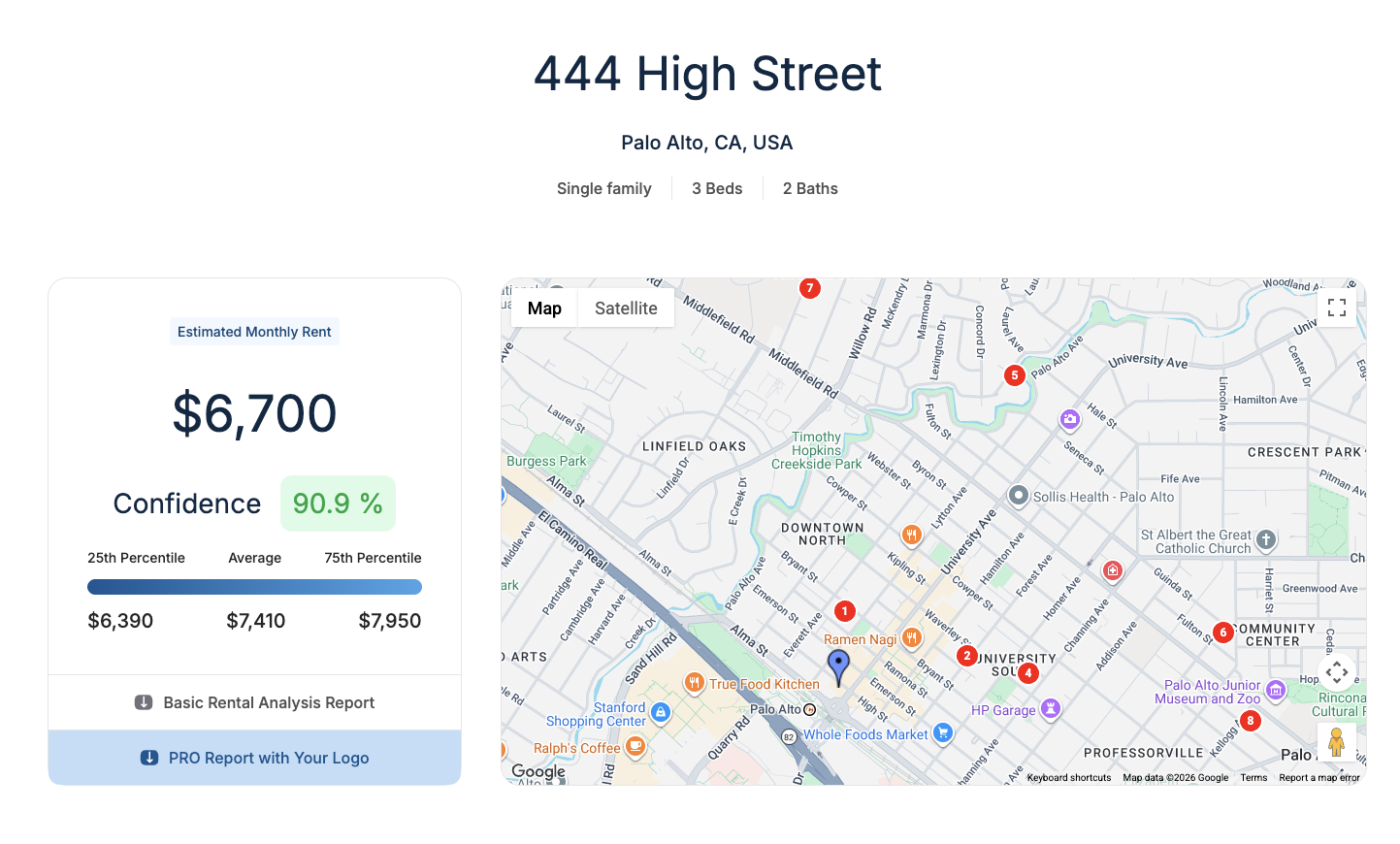
That's the same job — predict a rent — done in the open. You see the percentile band the comps form, a confidence score tied to how much real data backs it, and the listings themselves on the map. When the inputs are visible, you can tell a well-supported number from a thin guess, instead of taking one figure on faith.
The takeaway
How is the Zillow rent Zestimate calculated? A machine-learning model maps home features to nearby rents and scores your address against that pattern, refreshed from public records and listings. It's a strong way to cover every home in the country with a fast first number.
Its method also sets its limits: it prices recorded features, leans on asking rents, lags fast markets, and hides the comps. For a glance, that's fine. To actually set a price, work from an estimate that shows its math — the comps, the range, and the confidence behind the number.
See how your rent estimate is built, comp by comp, on Rentest.ai