
How Accurate Is the Zillow Rent Zestimate?
Price a unit $200 high off a bad Zestimate and it sits empty for a month. Price it low and you leave $2,400 a year on the table. Either way, the number you started with mattered.
So the question is fair: how accurate is the Zillow rent Zestimate? The honest answer is that it's a reasonable first glance and a bad thing to underwrite on. It's accurate enough to tell you the neighborhood, not accurate enough to set the price.
The Zestimate is a single modeled number with no comps shown. That's the whole problem — you can't see what it's built on, so you can't tell when it's wrong. A comp-based tool like RentEst answers the same question from the opposite direction: it shows the listings first and the number second.
What the Zestimate actually is
Zillow's rent Zestimate is a statistical model. It takes the home's features (beds, baths, square footage, location) and the rent signals it has nearby, and produces one number. Zillow publishes a national median error rate for it, but that national figure hides the cases that hurt you: the specific property where the model has almost nothing to work with.
The model is only as good as the data under any one address. In a dense, high-turnover market it has plenty to learn from. In a thin or unusual one, it's extrapolating — and it shows you the same confident-looking number either way. This is the gap RentEst was built to close: instead of one modeled figure, you get the comp set and a confidence score that moves with how much real data stands behind it.
Where the Zestimate breaks
The accuracy isn't uniform. It falls apart in four predictable spots.
- Thin comps. Rural areas, custom homes, and unusual unit types have few recent rentals nearby. With little to anchor on, the model leans on broader averages that don't reflect your block. RentEst surfaces this directly — a thin comp set produces a lower confidence score rather than an equally confident-looking number.
- Stale listings. Rent moves fast. A model trained on listings from six months ago lags a market that turned. In a softening or heating market, "lagging" means "wrong." RentEst stamps every comparable with a last-seen date, so an old comp set is visible immediately.
- Asking vs market rent. Most public rent data is asking rent — what landlords posted, not what tenants actually signed. Overpriced listings that sat for 60 days before cutting still feed the average. The Zestimate inherits that upward skew, and so does any tool built on listing data, RentEst included — the difference is that you can see which listings are doing it.
- Property specifics it can't see. A renovated kitchen, a finished basement, a bad floor plan, no parking. Two homes with identical beds and baths can rent $400 apart, and a feature-based model often misses the gap.
None of these show up as a warning. The Zestimate looks just as confident on the property it nailed as on the one it whiffed.
The real issue: you can't see the work
A Zestimate gives you a conclusion with no evidence. There's no list of which rentals it used, how far away they were, or how recent. So when the number feels off, you have no way to check why — you either trust it or you don't.
That's the opposite of how a pricing decision should work. The number isn't the point; the comps behind it are. RentEst is built on that premise: every estimate ships with the actual listings it used, so you can judge it yourself — are these real, recent, nearby, and similar?
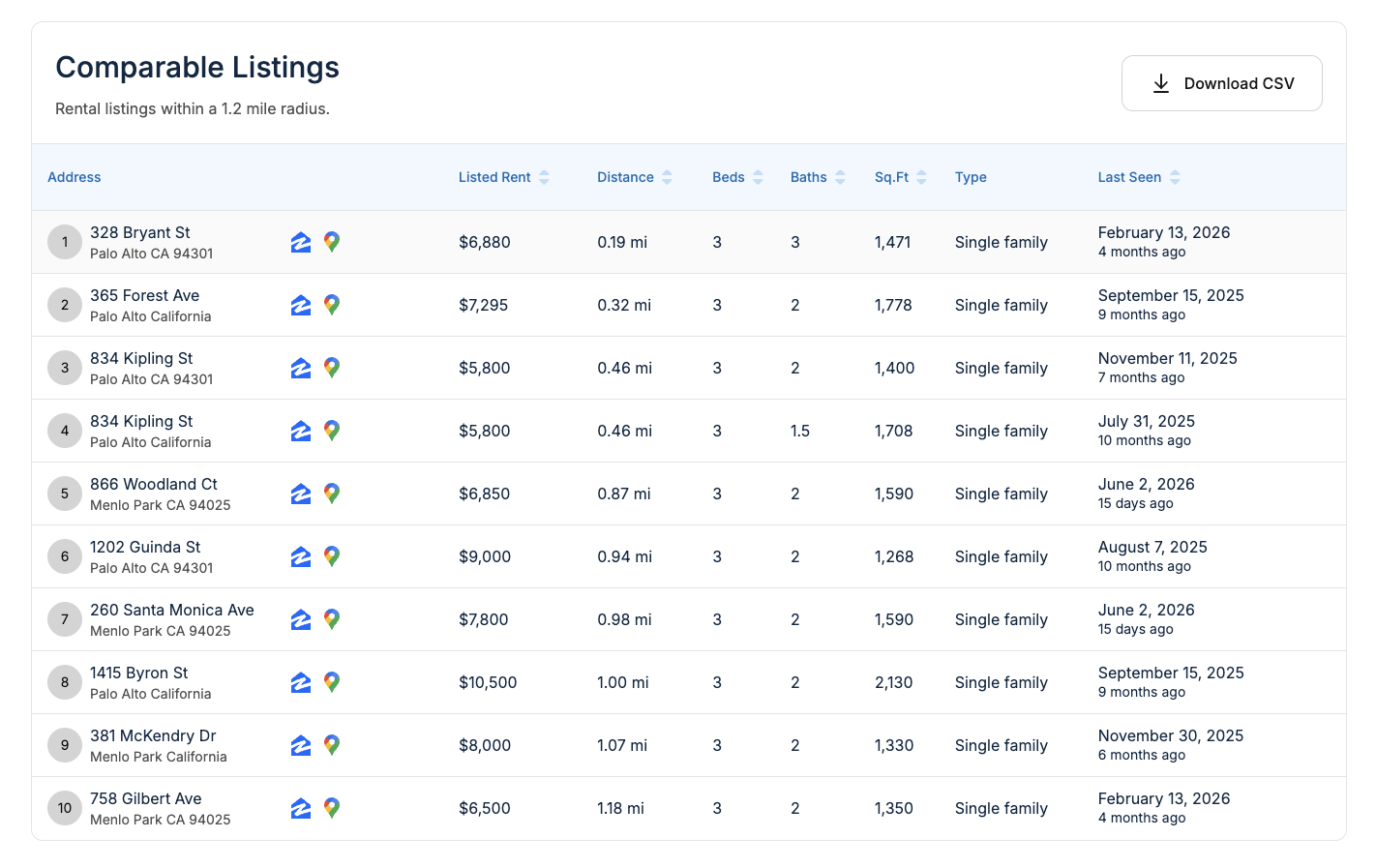
For every comparable, RentEst lists the address, listed rent, distance, beds and baths, square footage, type, and last-seen date, and lets you export the set to CSV. That's the difference between a black-box number and a defensible one. With the comps in front of you, a $3,000 estimate built on three listings two miles away in a different school zone is obviously shakier than one built on twelve listings on the same street last month — even if the model spits out the same figure for both.
How to sanity-check a Zestimate
You don't have to throw the Zestimate out. Treat it as a hypothesis and test it.
- Pull the comps yourself. Find 5–10 recently listed rentals that match on beds, baths, and rough size within about a mile. If the Zestimate sits inside that cluster, it's probably fine.
- Check recency. Weight listings from the last 60–90 days. A comp from last spring is a data point, not the answer.
- Separate asking from leased. If the comps that actually rented are lower than the ones still sitting, the market rent is the lower number.
- Adjust for the property. Move up or down from the comp range for condition, parking, layout, and amenities the model can't see.
- Look at the spread, not just the midpoint. A tight range of similar comps is a confident number. A wide, scattered range means price conservatively and watch the response.
That whole checklist is what a RentEst estimate does in one step — it shows the listings, the distances, and the dates, so the sanity-check is the tool instead of a manual afternoon. RentEst estimates are free for any U.S. address, which makes running one as a second opinion cost nothing.
The takeaway
How accurate is the Zillow rent Zestimate? Accurate enough to point you at the right neighborhood, not accurate enough to set a price on. It breaks on thin comps, stale data, asking-vs-market skew, and property specifics — and it never tells you which case you're in.
The fix isn't a better single number. It's seeing the comps behind the number so you can judge it yourself. RentEst starts from that evidence — the comp set, the percentile range, and a confidence score — rather than handing you the conclusion.
Check the comps behind your rent estimate with RentEst.ai
