
Why Free Rent Estimates Are Often Wrong (And When They’re Still Useful)
Type an address into a free rent estimator and you get a monthly rent in seconds. The number looks authoritative. The problem is what sits behind it — usually nothing you can check.
For a landlord setting a price, a PM advising a client, or an investor underwriting a deal, a wrong estimate isn’t a rounding error. Price 8% high and the unit sits empty for a month. Price low and you give away cash flow for the length of the lease.
Free estimates aren’t useless. But you have to know where they break.
What an accurate estimate actually looks like
Here’s a real rent estimate for 3203 Conrad Lane in Katy, TX — a 4-bed, 3-bath single-family home.
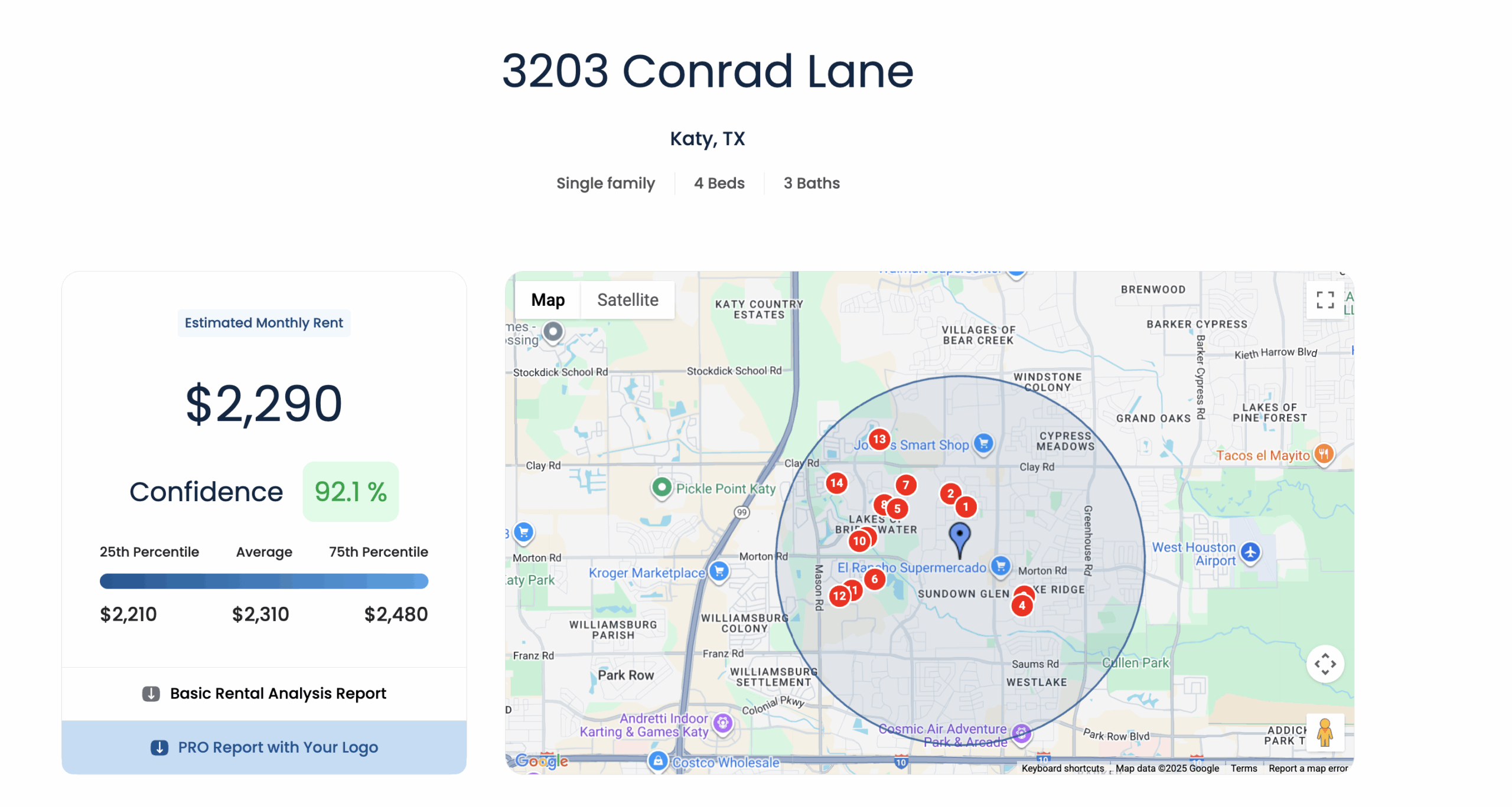
The headline number is $2,290. But notice what’s shown with it:
- A percentile range, not just an average — 25th at $2,210, average $2,310, 75th at $2,480. That spread tells you how much room you have to push price.
- A confidence score — 92.1% here, because there were enough close, recent comps to trust it.
- The comps themselves, plotted on a map inside a defined search radius, so you can see exactly which rentals the number is built on.
A free estimate that returns just “$2,290” is asking you to trust all of that on faith. That’s the real difference — not the number, but everything around it.
Why free rent estimates are often wrong
- The data is thin or stale. Free tools lean on limited public listings or older records. In smaller or fast-moving markets, the comps behind your number may be months — sometimes years — old. Rents move with seasonality and local supply, so a lagging dataset produces a lagging number.
- They average across too wide an area. Blending rents across a whole ZIP code smooths over what actually sets price: school zones, transit access, street-level desirability, new supply two blocks over. Two homes a mile apart can rent $400 apart, and a wide average misses both.
- They ignore the property itself. Most free estimators stop at beds and baths. They don’t see renovation quality, lot size, parking, or condition. So a renovated unit gets undervalued and a tired one gets overestimated — with no way to tell which.
- They hide the comps. The big one. A single number with no comp count, no distance, and no recency is impossible to sanity-check. When you can’t see the comparables, you can’t catch the bad ones — and there are always bad ones.
When a free estimate is still fine
It’s the wrong tool for setting a price, but the right tool for a few jobs:
- Triage at volume. Screening 40 listings to spot the obviously overpriced ones.
- A first ballpark. Confirming you’re in the right range for a city before you dig in.
- Top-of-funnel lead capture. Fine as a hook for prospects — as long as the real analysis comes next.
The mistake is treating a triage tool as a pricing tool.
How to pressure-test any rent estimate
- Start with a broad comp search, then check how many comps it actually used.
- Narrow filters one at a time — property type, then size — and watch the number move.
- Compare median against average. A big gap means outliers are dragging it.
- Eyeball a few nearby active listings yourself.
If the estimate falls apart when you do this, it was never reliable.
Free vs. data-driven estimates
| Feature | Free Rent Estimates | Data-Driven Tools |
|---|---|---|
| Comp transparency | Limited or none | Full — count, distance, recency |
| Percentile range | Rarely | Yes (25th / median / 75th) |
| Filtering | Beds/baths only | Property type, size, radius |
| Market recency | Often stale | Frequently updated |
| Best use | Rough triage | Pricing & underwriting |
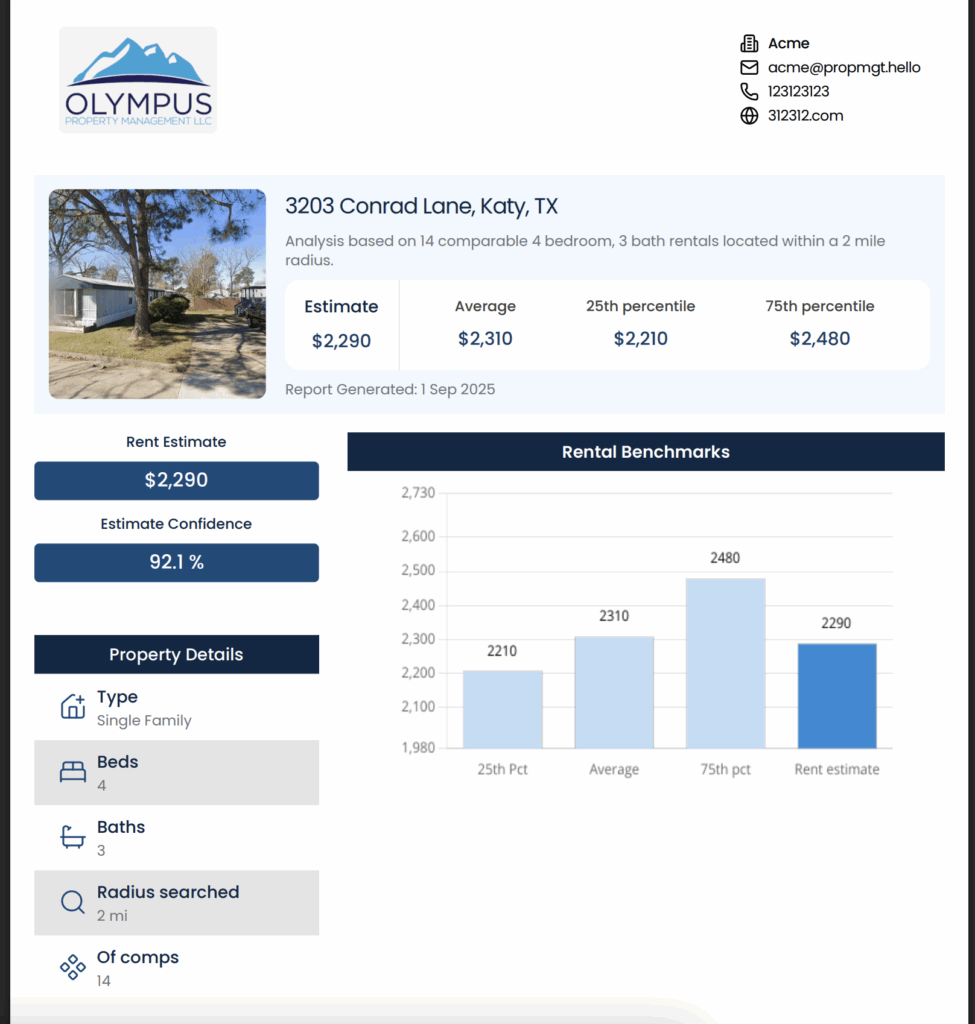
And when you need to hand the analysis to a client or an owner, the same data goes into a branded report — every comp, the radius, the percentile range, and the confidence, all on the page:
The takeaway
Free rent estimates aren’t “wrong” so much as incomplete. They’re fine for moving fast early on. They shouldn’t be the last word when you’re setting rent, underwriting a deal, or advising a client.
When accuracy matters, you want transparent comps, a real range, and the ability to drill in. That’s the line between guessing and deciding.
Run a transparent, comp-backed estimate on RentEst.ai →
Frequently asked questions
Are free rent estimates reliable? They’re directionally helpful but often inaccurate, because of thin data and wide-area averaging.
Why do two tools show different numbers for the same address? Each uses different data sources, comp-selection rules, and update frequencies.
Can I use a free estimate to price a rental? Only as a starting point. Validate against recent local comps before you set a price.
How often should I re-check? In active markets, before each lease — or every few months at minimum.
What’s the most common mistake? Trusting a single number without ever looking at the comps behind it.