
Rent Comps vs Zillow Estimates: What Investors Should Actually Trust
Investors live and die by their numbers. One optimistic rent assumption turns a "great deal" into a cash-flow problem the day the lease signs.
So the question comes up constantly: should I trust rent comps, or is a Zillow rent estimate good enough?
They're built for different jobs. A Zillow estimate is a quick glance. Rent comps are what you underwrite on. Here's the difference, and where each one breaks.
A Zillow estimate is a number. Comps are the evidence.
Take 3203 Conrad Lane in Katy, TX — a 4-bed, 3-bath single-family home. Here's what RentEst shows for it:
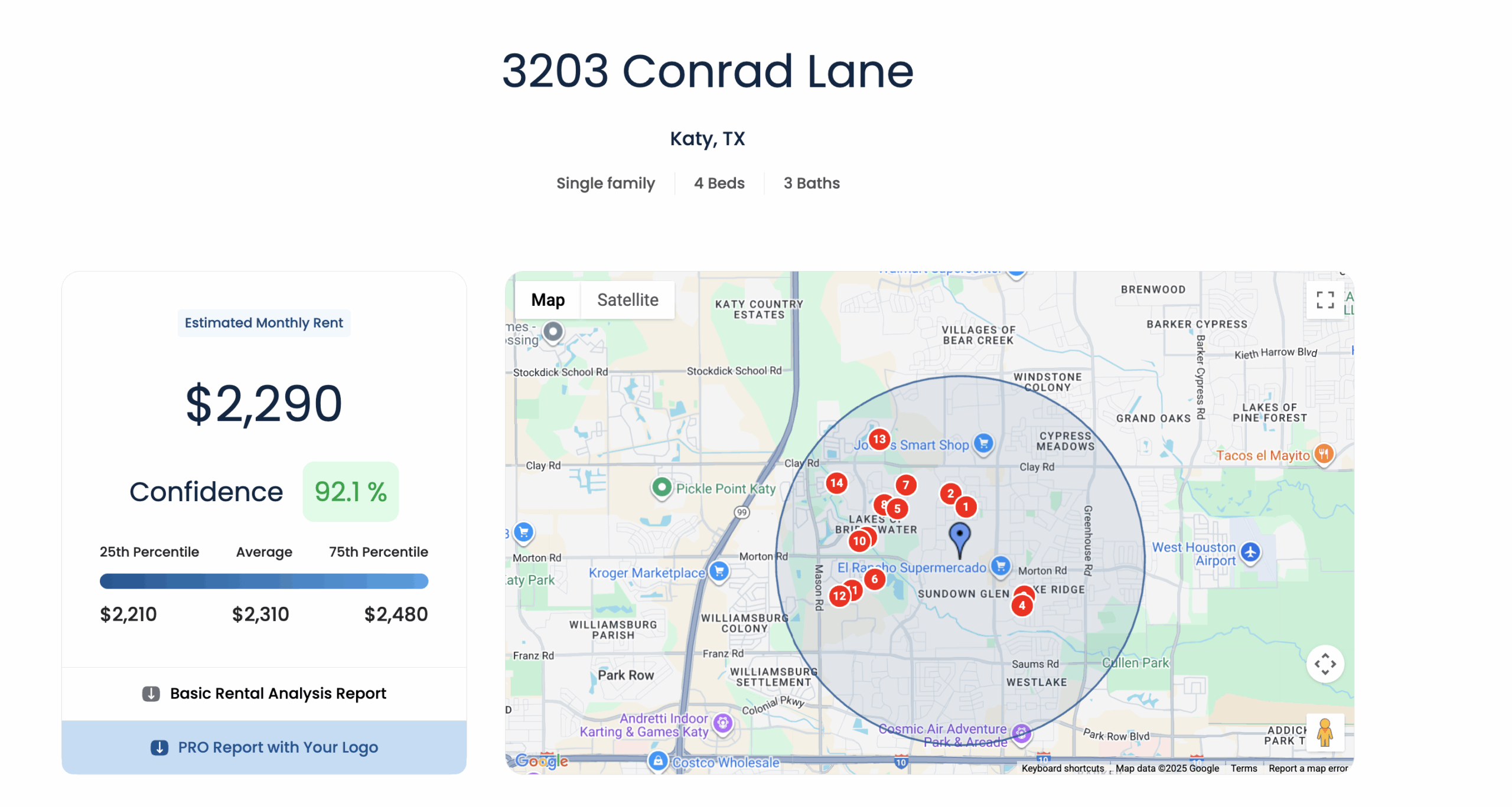
From RentEst you don't just get $2,290. You get the range ($2,210 at the 25th, $2,480 at the 75th), a confidence score, and the actual comps on a map inside a defined radius. You can see exactly which rentals built the number — and throw out the ones that don't fit.
A Zillow rent estimate gives you the $2,290 and nothing to check it against.
What rent comps are
Rent comps are real rental listings and lease data from similar nearby properties. Good ones match on:
- Location — same neighborhood or a tight radius
- Property type — single-family, condo, apartment
- Beds and baths
- Square footage
- Recent lease dates
Investor-grade comps don't stop at one number. They show ranges, distribution, and outliers — which is the whole point when you're sizing downside risk. RentEst lists every comparable with its address, listed rent, distance, beds and baths, square footage, type, and last-seen date, and exports the set to CSV.
What a Zillow estimate is
The Zillow rent estimate ("Zestimate for rent") is an automated model output. It blends listing data, historical trends, property attributes, and market-wide smoothing.
It's fast and convenient, and it's aimed at homeowners checking rent potential and renters browsing listings. It is not built to underwrite a risk-sensitive deal.
The core differences
| Factor | Rent comps in RentEst | Zillow rent estimate |
|---|---|---|
| Data source | Actual nearby listings & leases | Algorithmic model |
| Transparency | You see every comparable | Black-box output |
| Granularity | Property-level detail | Smoothed averages |
| Outliers | Visible and adjustable | Hidden in the model |
| Best use | Underwriting & deal analysis | Rough directional signal |
Where Zillow estimates mislead
The Zestimate breaks down in exactly the spots investors care about most:
- Transitional neighborhoods where rent changes block by block
- Thin markets with few recent rentals
- Unique properties that don't fit a clean average
- Fast-moving markets the model hasn't caught up to
Because the output is smoothed, it still looks "reasonable" when it's materially wrong — and that's what gets baked into a cash-flow or DSCR model. RentEst handles the same situations by scoring confidence down and showing you the thin comp set, so a weak number identifies itself.
A practical framework
How experienced investors use both:
- Start broad — a quick estimate to read the neighborhood
- Switch to comps for the real underwriting; a RentEst estimate is free for any U.S. address
- Stress-test the deal at the 25th-percentile rent, not the median — RentEst shows the 25th/median/75th band directly
- Document the comps for your lender and partners
Lenders back this up: most want documented comps, not an automated estimate. And when you hand the analysis to a partner or owner, the same comps go straight into a branded RentEst PRO report:
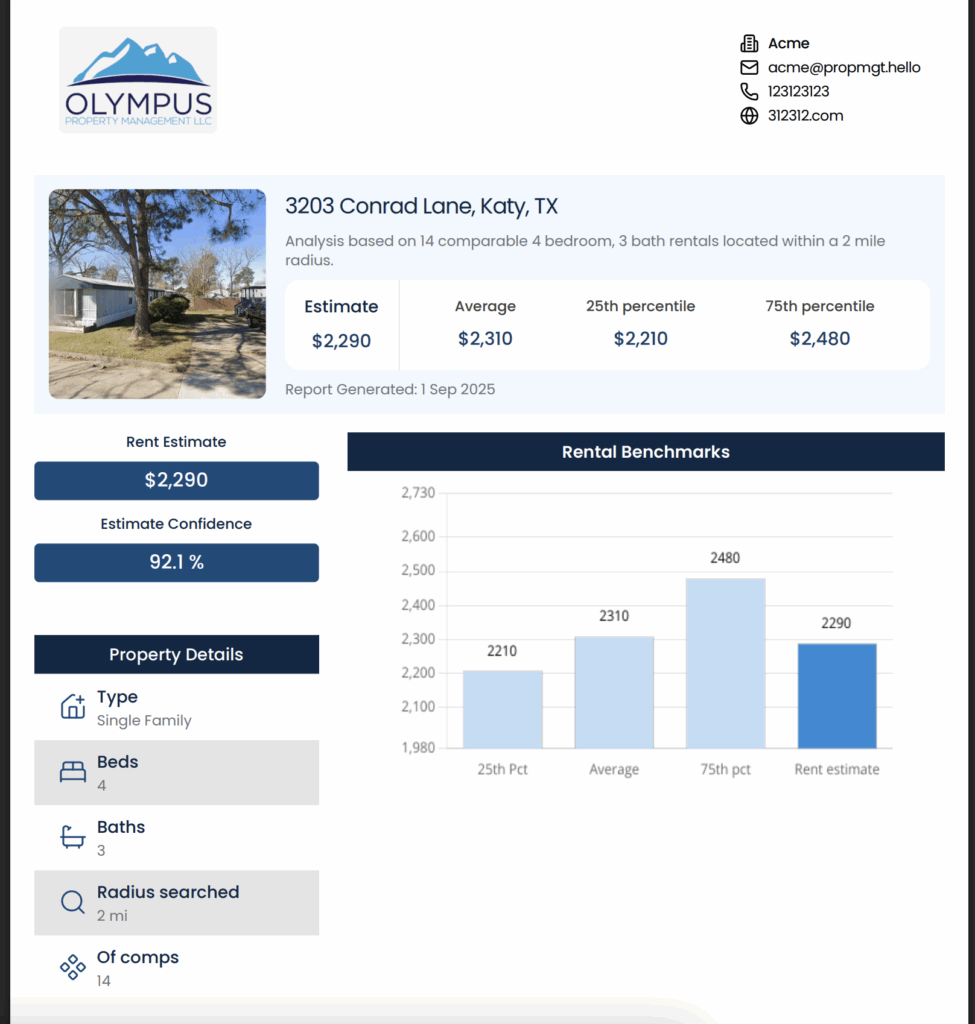
The RentEst PRO report carries the estimate, a benchmarks chart, the search radius, and every comp used, under your own branding — which is what a lender or an owner actually wants to see.
The takeaway
A Zillow estimate is fine for a quick glance. When real money is on the line, the comps are the source of truth. If you can't see the comps behind a number, you can't assess the risk. RentEst is built around that: the comp set first, the estimate second.
Pull real rent comps for your next deal on RentEst.ai →
Frequently asked questions
Are Zillow rent estimates ever accurate? In stable, uniform neighborhoods they can be directionally right. Accuracy drops fast in mixed or thin markets.
How many comps are enough? Generally 8–15 quality comps within a tight radius give a strong signal. RentEst shows the count and the confidence score behind every estimate so you can check.
Should I ignore Zillow completely? No — use it as a starting point, then verify it against a visible comp set in RentEst before you underwrite.
Do lenders prefer comps? Yes. Most want documented comps, not automated estimates — which is what a branded RentEst PRO report is for.