
How Accurate Is the Redfin Rent Estimate?
Redfin shows a rent estimate on a property page the same way it shows a sale price — clean, confident, one number. If you're setting a rent or sizing up a rental deal, the fair question is whether that number is solid enough to act on.
Short answer: it's a decent first read, not a price. Redfin's rent estimate is good enough to tell you the ballpark and risky to underwrite on. Like every automated estimate, it's accurate where the data is rich and shaky where it's thin — and it shows you the same tidy figure in both cases.
Here's where the Redfin rent estimate holds up, where it slips, and how to check it against a comp set you can actually see.
What the Redfin rent estimate is
Redfin grew up as a brokerage, so its strength is sale-side data pulled straight from the MLS. The rent estimate is a separate automated model that predicts a monthly rent from the home's features and the rental signals nearby.
That brokerage DNA cuts both ways. Redfin is excellent at for-sale comps; rental listings are a thinner, messier dataset that no single site sees in full. So the rent estimate is working from less and noisier data than the sale-price tools it sits next to. RentEst is built only for the rental side, and it publishes the comp set behind each number rather than a standalone figure.
Where the Redfin estimate slips
Accuracy isn't uniform. It degrades in the same predictable places every model-based estimate does.
- Thin rental data. Many areas simply don't have many recent rental listings. Where the model has little to learn from, it leans on broader averages that may not fit your block. RentEst handles this by scoring confidence down instead of quietly widening its net.
- Stale comps. Rent moves faster than the data refreshes. In a market that just turned, an estimate anchored to older listings reflects last season, not this one. Every RentEst comp carries a last-seen date for exactly this reason.
- Asking, not leased. Most public rent data is what landlords posted, not what tenants signed. Overpriced listings that sat for weeks still pull the average up. RentEst draws on the same public listing data and inherits the same skew — but it shows you which listings are responsible.
- Features it can't see. A renovated kitchen, in-unit laundry, parking, a bad layout. A model that knows beds and baths but not condition can miss two similar homes that rent hundreds apart.
- One number, no comps. Like its peers, Redfin hands you a conclusion without the listings behind it, so you can't tell a well-supported estimate from a thin guess.
The catch is that none of this is flagged. The estimate looks identical whether it had thirty good comps or three bad ones.
The same tool, two very different numbers
The clearest way to see why "how accurate" has no single answer: look at what a thin-data estimate actually looks like when the tool is honest about it.
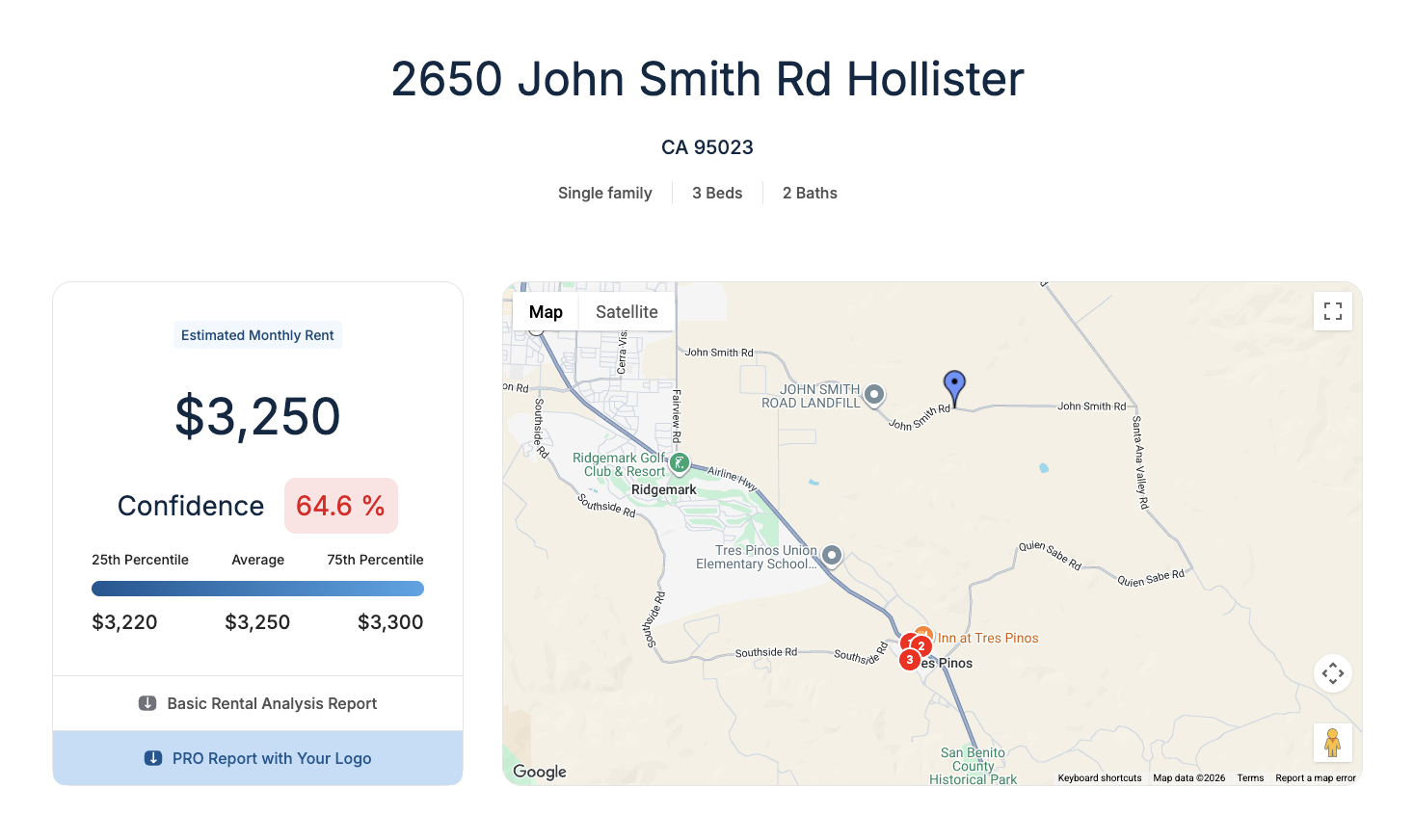
Run 2650 John Smith Rd in Hollister, CA through RentEst and it returns $3,250 at 64.6% confidence, flagged red — built on roughly three comps, clustered far away, in a thin rural market. This is a number you should not price on, and the only reason you know that is the confidence score and the visible comps that RentEst puts next to it.
A tool that hides all of this would show you $3,250 with the same confidence it shows a number backed by twelve fresh comps next door. RentEst colors the score — red, yellow, or green — so the weak estimates announce themselves. Accuracy lives in that context, not in the figure itself.
How to check a Redfin rent estimate
Treat the estimate as a hypothesis and test it before you lean on it.
- Pull your own comps. Find 5–10 recently listed rentals that match your real beds, baths, and rough size within about a mile. If the estimate sits inside that cluster, it's probably fine. A free RentEst estimate does this step for you on any U.S. address.
- Weight recency. Favor listings from the last 60–90 days. Old comps describe an old market.
- Separate asking from leased. If the listings that actually rented sit below the ones still up, the lower number is closer to market.
- Adjust for the property. Move up or down from the comp range for condition, parking, and layout the model can't see.
- Mind the spread. A tight cluster is a confident number. A wide, scattered one means price conservatively and watch the response. RentEst shows the 25th/median/75th band so the spread is explicit.
The takeaway
How accurate is the Redfin rent estimate? Accurate enough to point you at the right range, not accurate enough to set a price on — and least reliable exactly where rental data is thin, which it rarely admits. Redfin's sale-side comps are strong; its rent estimate is working with less.
The fix isn't trusting or tossing the number. It's checking the comps and the confidence behind it, so you can tell the solid estimates from the guesses. That's the job RentEst does: a free estimate for any U.S. address, a scored confidence level, and every comparable listed with its distance, size, and last-seen date.
See the comps and confidence behind your rent estimate on RentEst.ai