
How Accurate Is the Apartments.com Rent Estimate?
Apartments.com is one of the biggest rental marketplaces in the country, so when its tool hands you a rent estimate it carries some weight. If you're pricing a unit or underwriting a deal, the question is whether that estimate matches the kind of property you actually have.
Short answer: it depends heavily on the property type. Apartments.com is strongest at what it does most — large, professionally managed apartment communities. For a single-family rental or a small multifamily, its estimate is working from thinner, skewed data, and it doesn't flag the difference.
Here's where the Apartments.com rent estimate holds up, where it tilts, and how to check it before you price on it.
What the Apartments.com estimate is built on
Apartments.com is a listings marketplace. Its rent data comes overwhelmingly from the properties it lists — and that inventory leans hard toward big managed complexes that advertise units there.
That shapes the estimate. The model has rich data on large apartment communities and far less on the rental house down the street or the duplex on the corner. It's a marketplace first, so its estimate reflects the slice of the market that markets on it. RentEst isn't a marketplace, so it has no inventory to favor — it pulls comparable listings around your address and shows you which ones it used.
Where the estimate skews
The accuracy tracks the data, so it tilts in predictable directions.
- Apartment bias. The dataset is dominated by managed multifamily. Estimate a single-family home or a 2–4 unit building and you're asking a model trained on apartment complexes about a very different product. RentEst lists the property type of every comp, so a house-priced-off-apartments problem is visible on the page.
- Asking, not leased. Marketplace data is advertised rent — what landlords posted, not what tenants signed. Concessions ("two months free") and overpriced units that sat for weeks still feed the number, which can hold the estimate above true market. RentEst works from listing data too, so the same caveat applies — the difference is that you can inspect the individual comps.
- Big-building amenities baked in. Complex rents often include pools, gyms, and on-site management. Comparing a private rental to that inventory can read high if those amenities are quietly in the mix.
- Thin single-family coverage. Where Apartments.com lists few houses, the estimate extrapolates from whatever is nearby, which may be apartments priced on a different logic. RentEst matches the exact bed/bath combination rather than bucketing them, which keeps mismatched units out of the set.
- One number, no comps shown. Like its peers, it gives you a figure without the listings behind it, so you can't see whether the comps were apartments or houses, recent or stale.
None of this surfaces as a warning. The estimate looks just as confident on a single-family home as on a unit inside a 300-door community it knows well.
Accuracy isn't one number — it's the confidence behind it
"How accurate" has no single answer because it changes property to property. What you actually want is a read on how much real, matching data backs this estimate — and a tool that shows it.
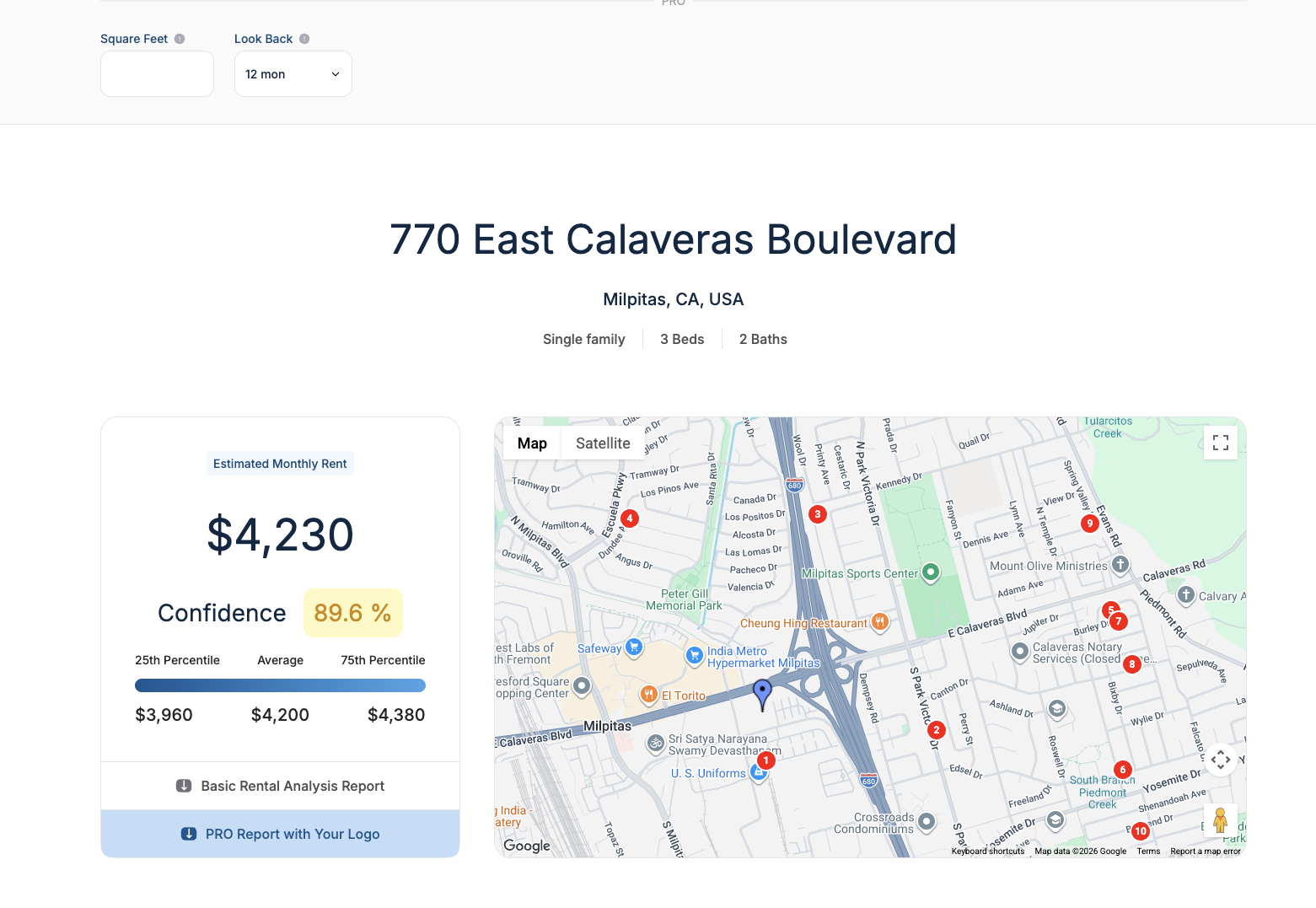
Run 770 E Calaveras Blvd in Milpitas through RentEst and it returns $4,230 at 89.6% confidence, marked yellow, on a tight $3,960–$4,380 comp range. That score and range tell you this is a number you can mostly trust, but still worth a look.
RentEst colors the confidence score so the read is immediate: green means you can lean on it, yellow or red means dig into the comps first. Apartments.com gives you the figure without that signal, so a shaky single-family estimate looks identical to a rock-solid apartment one.
How to check an Apartments.com estimate
Treat it as a starting point and verify against the right comps.
- Match the property type. For a house, compare to recently listed houses, not apartment-complex units. For small multifamily, find similar small buildings. RentEst shows type on every comp row so you can filter by eye.
- Pull recent comps. Find 5–10 listings from the last 60–90 days that match your real beds, baths, and rough size within about a mile.
- Strip out concessions. A unit advertised at $2,400 with two months free is really renting for less. Adjust asking rents down to the effective number.
- Watch for amenity inflation. If your comps are amenity-loaded complexes and your property isn't, expect to price below them.
- Look at the spread. A tight cluster of matching comps is a confident number. A wide, mixed range means price conservatively and watch the response.
The takeaway
How accurate is the Apartments.com rent estimate? Reliable for the large managed complexes that make up most of its data, and noticeably weaker for single-family and small multifamily, where its inventory is thin and apartment-biased. It also leans on asking rents, which can run above market.
The fix is the same as for any black-box estimate: match the comps to your actual property type and read the confidence behind the number. A RentEst estimate is free for any U.S. address and gives you both — the scored confidence and every comparable it used, with type, distance, size, and last-seen date.
See the comps and confidence behind your rent estimate on RentEst.ai