
Is Rentometer Accurate?
Rentometer is fast and free, which is why so many landlords start there. Type an address, pick a radius, get a rent range in seconds. The question is whether the number that comes back is good enough to price on.
The honest answer: sometimes. Rentometer is accurate when the conditions are kind — a dense area, lots of recent listings, a common unit type. It gets shaky exactly where its radius-and-comp model runs out of road. The trouble is the output looks the same either way.
Here's where the model holds up, where it breaks, and how to check any rent estimate against the comps behind it — whether that estimate comes from Rentometer or from RentEst.
How Rentometer builds its number
Rentometer works by pulling rental listings within a radius of your address and summarizing them into a range. You can widen or narrow the radius, and the tool recomputes.
That's a reasonable approach, and in the right market it's genuinely useful. But the whole result rests on two things: which listings fall inside that circle, and whether those listings actually match your property. Both can go wrong quietly. RentEst starts from the same kind of public listing data, but keeps the comp set on screen, so you can see which listings drove the number instead of inferring it from a slider.
Where the radius model breaks
The accuracy isn't constant. It degrades in predictable spots.
- Thin markets. Drop a radius on a rural or low-density area and you catch only a handful of listings — sometimes three or four. A range built on that little is a guess dressed as a number. Widen the radius to find more and you start pulling in places that aren't comparable. RentEst attaches a confidence score to every estimate, so a thin comp set shows up as a lower score rather than a clean-looking range.
- The radius is a blunt tool. A circle treats a comp half a mile across a highway the same as one on your street. Neighborhoods don't work in circles. A fixed radius mixes price tiers, school zones, and street quality the model can't distinguish. RentEst lists each comparable's exact distance, so you can drop the ones sitting on the wrong side of a barrier.
- Stale listings. If the recent listings are sparse, older ones carry more weight. In a market that moved, that drags the estimate toward last season's rents. RentEst stamps every comp with a last-seen date, which makes an old comp set obvious at a glance.
- Mismatched comps. Beds and baths are a coarse filter. A radius can sweep in a renovated unit and a tired one, a place with parking and one without, and average them into a single midpoint that fits neither. RentEst matches the true bed/bath combination rather than bucketing baths into a "1.5+" band, and shows square footage per comp so size mismatches are visible.
- Asking, not leased. Like most public rent tools, the listings are what landlords asked, not what tenants signed. Overpriced listings that sat for weeks still count. This one applies to RentEst as well — it's a limitation of public listing data, not of any single tool, and the honest fix is reading the comps rather than trusting any single midpoint.
None of this shows up as a warning. The tool returns a clean range whether it had forty good comps or four bad ones.
The fix: see the comps, not just the radius
The way to know if any radius-based number is trustworthy is to look at the listings behind it. That is the design principle behind RentEst: not a circle and a range, but the actual comps, with their distance, size, and recency, so you can throw out the ones that don't belong.
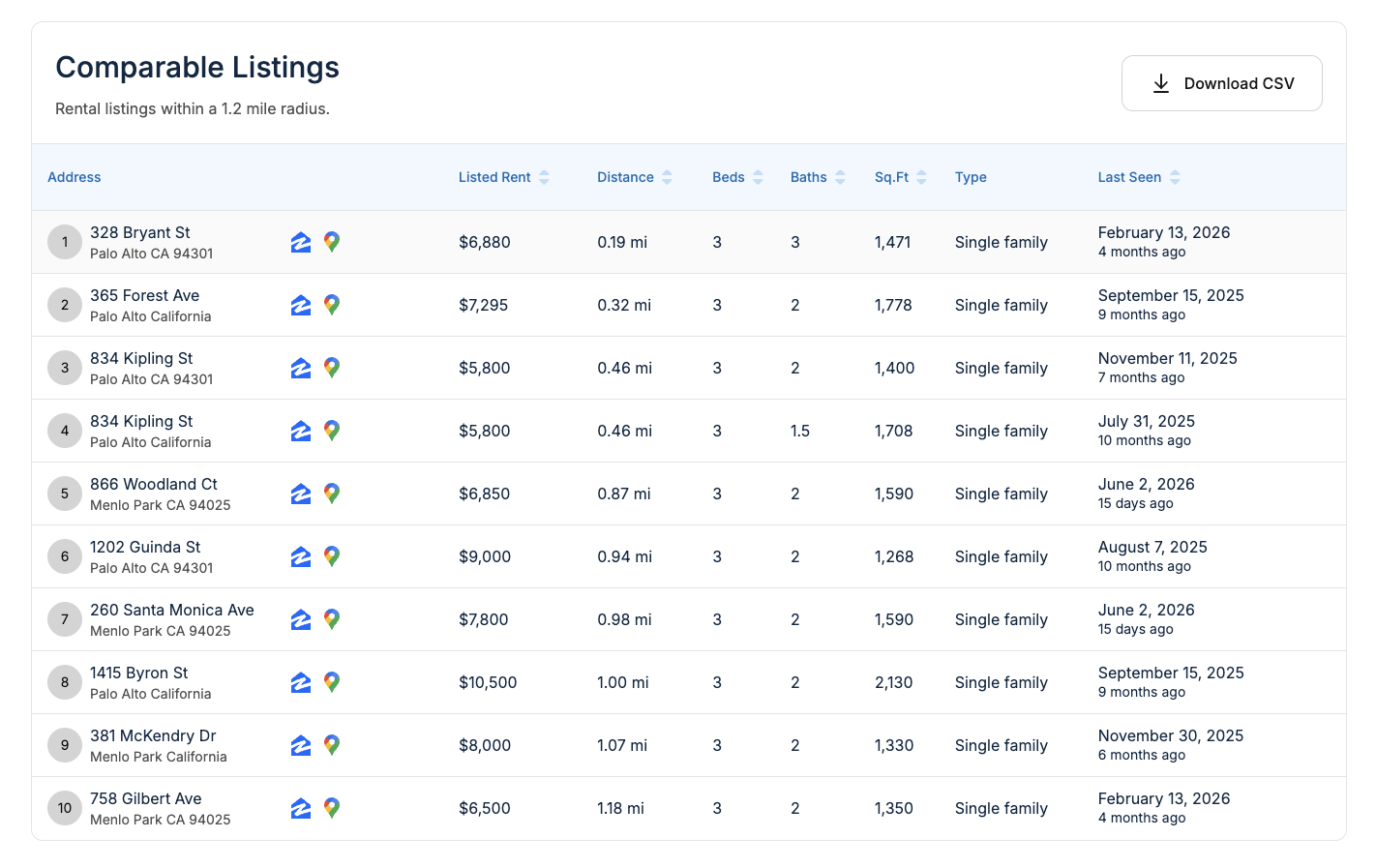
RentEst returns a free rent estimate for any U.S. address and shows every comparable it used to build that number. That's the difference between adjusting a slider and actually checking the work. When RentEst shows that two of your comps are 1.2 miles out and four months old, you know to discount them. When it shows eight fresh listings on nearby streets that match your beds, baths, and size, you can price with confidence. The radius stops being a black box and becomes something you can audit.
What RentEst shows that a radius doesn't
RentEst is built around the comp table rather than the range. For every comparable it pulls, RentEst lists:
- Distance — the actual distance from your address, not just the radius you picked.
- Beds and baths, matched exactly — RentEst filters on the true bed/bath combination, so a 1-bath and a 3-bath don't land in the same comp set.
- Square footage — so you can see which comps are genuinely the same size as your unit.
- Last-seen date — so stale listings are obvious instead of silently weighted.
- CSV export — download the full comp set from RentEst and keep the ones you can defend.
Rent estimates on RentEst are free for any U.S. address. The RentEst Pro plan adds branded reports and API access at $11/mo.
How to sanity-check a Rentometer estimate
You don't have to abandon it. Treat the range as a first read and verify it — against the comps, or against a second free estimate from RentEst.
- Count the comps. If the range rests on only a few listings, widen your search and expect less precision. The RentEst confidence score reflects exactly this.
- Inspect distance, not just the radius. Throw out comps across a barrier or in a clearly different pocket, even if they're inside the circle.
- Check recency. Weight listings from the last 60–90 days. Old comps describe an old market, which is why RentEst surfaces a last-seen date on every row.
- Match the unit. Filter to your real beds, baths, and rough size, then adjust up or down for condition, parking, and layout.
- Separate asking from leased. If the listings that actually rented sit below the ones still up, the lower number is closer to market.
The takeaway
Is Rentometer accurate? In a dense market with fresh, matching listings, it's a fine starting point. Its radius-and-comp model breaks in thin markets, on stale or mismatched comps, and wherever a circle blurs neighborhood lines — and it never tells you which case you're in.
The reliable move isn't trusting the range or tossing it. It's reading the comps behind it, so you can keep the good ones and drop the rest. RentEst was built for that check: a free rent estimate for any U.S. address, with every comparable visible, filterable, and exportable.
Check the comps behind your rent estimate with RentEst.ai