
Why Median Rent Beats Average Rent for Smarter Pricing Decisions
Most landlords reach for the average rent when setting a price. It's familiar and easy to find. It's also the number most likely to leave your unit sitting empty.
In real rental markets, prices aren't symmetrical — a handful of high-end units drag the average up. Price a typical home off that inflated number and you overshoot the market. For real pricing decisions, median rent is the safer anchor.
Average vs. median: the difference that matters
| Metric | How it's calculated | Main weakness |
|---|---|---|
| Average rent | Total rent ÷ number of listings | Skewed by luxury or outlier units |
| Median rent | The midpoint (50% above, 50% below) | Barely moves with extremes |
In urban or mixed neighborhoods, a few luxury condos or furnished short-term rentals can pull the average hundreds of dollars above where most leases actually clear.
See it on a real property
Here's 3203 Conrad Lane in Katy, TX — a 4-bed, 3-bath single-family home:
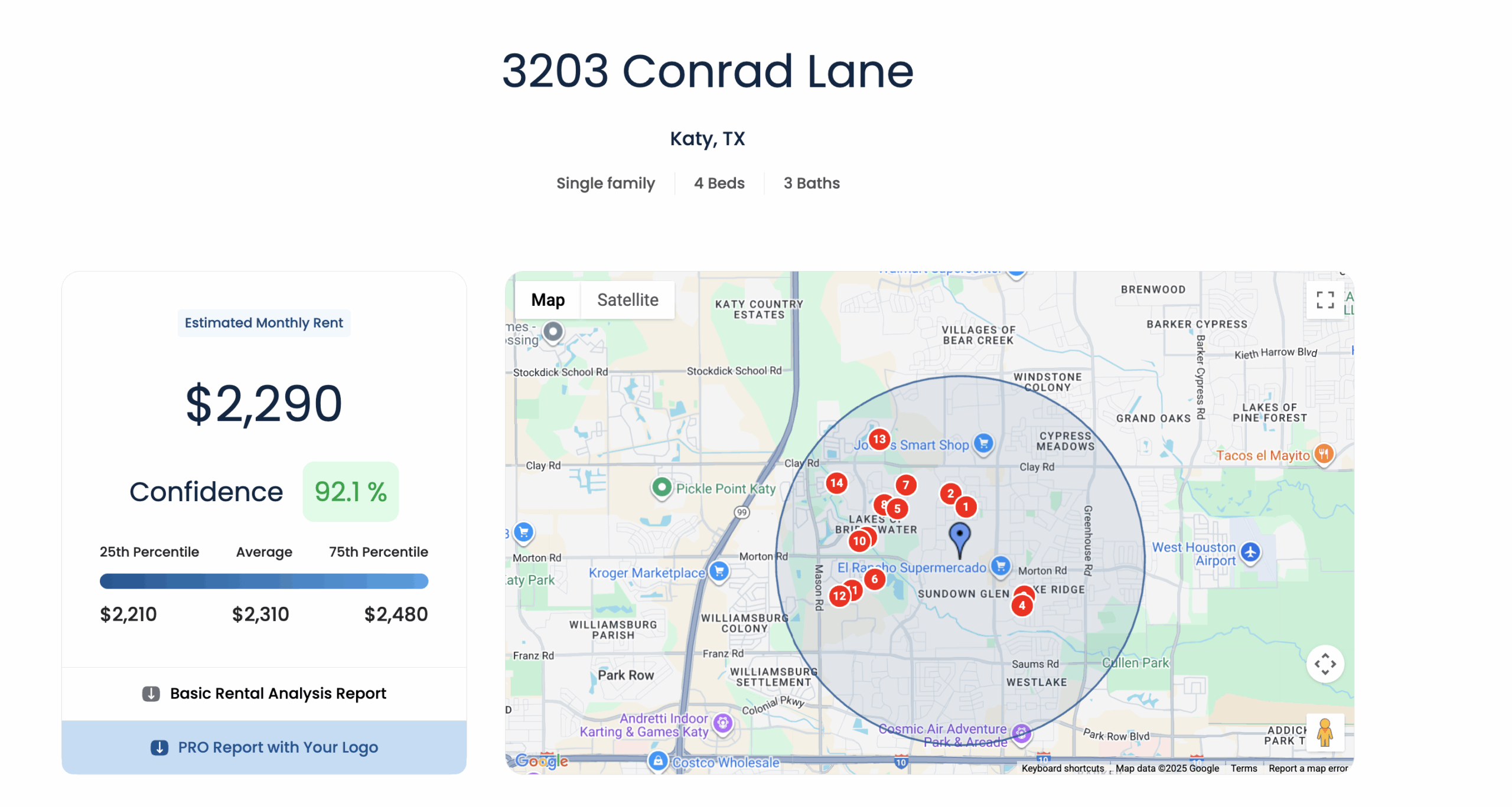
Notice the spread: 25th percentile $2,210, average $2,310, 75th percentile $2,480. The average sits above the typical-renter midpoint because the high-end comps pull it up. Anchor on the middle of the distribution and the percentile range, not a single inflated average.
Why average rent misleads
- Outliers distort the signal. Luxury condos, new builds, and furnished rentals push the average up. Price a standard unit off it and you land above what most renters pay.
- It ignores where demand clusters. Most renters sit near the middle of the market. Median reflects that; average can be swung by a few atypical listings.
- Overpricing compounds into vacancy. A unit priced 5–8% over market sits empty longer — and one extra vacant month erases the "upside" the inflated average suggested.
When average rent still helps
Average isn't useless — it's situational:
- High-end or luxury-only buildings
- Very uniform property types (identical apartment complexes)
- Long-horizon, macro trend analysis
For most single-family homes, small multifamily, and mixed neighborhoods, median is the safer anchor.
A median-first pricing framework
- Start from the median of recent comparable listings
- Read the 25th–75th percentile range to see your spread
- Adjust for condition, amenities, and location
- Cross-check against live comps before you list
This keeps you competitive while minimizing vacancy risk. RentEst surfaces median, average, and percentile ranges together, so you see the full distribution instead of one number.
The takeaway
Average rent tells a story. Median rent tells the truth. If you want faster leasing and defensible pricing, anchor on the median and the percentile range — use the average only as supporting context.
Run a percentile-backed rent estimate on RentEst.ai →
Frequently asked questions
Is median always better than average? In most mixed or skewed markets, yes. It better reflects what a typical renter pays.
Why do platforms still highlight average rent? It's easier to compute and explain — but it's far less resilient to outliers.
Should I ignore average rent entirely? No. Use it alongside median and percentile data for the full picture.
Which percentile range is most useful? The 25th–75th range captures realistic pricing flexibility.