
The Tradeoff Between Faster Leasing and Higher Rent: A Data Perspective
Setting rent is rarely about finding the single right number. It is a tradeoff between leasing faster and charging more per month. Push rent too high and days on market climb. Price too low and you fill quickly but leave money on the table.
The number that matters is not headline rent. It is effective rent after vacancy — what you actually collect across the year.
This post works that tradeoff with real math: how price affects lease-up speed, when faster leasing wins, and where the optimal pricing band usually sits.
Why pricing is a speed-vs-revenue decision
Every market has a demand curve. As asking rent rises, the pool of qualified tenants shrinks and lease-up time grows. As rent falls, demand rises and the unit fills faster.
The key insight: the goal is not the highest rent, it is the highest effective rent after vacancy.
The hidden cost of vacancy stacks up fast:
- Each vacant month is roughly 8% of annual rent gone.
- Carrying costs continue — utilities, maintenance, taxes.
- Long vacancies often trigger concessions later.
That is why experienced operators judge price through a net-revenue lens, not a monthly-rent lens.
The math in action
Take a unit where market rent is $2,000. Compare three strategies over a 12-month period, accounting for the vacancy each one carries:
| Strategy | Asking rent | Vacancy | Months collected | Annual net |
|---|---|---|---|---|
| Below market | $1,900 | ~0.5 mo | 11.5 | $21,850 |
| At market | $2,000 | ~1 mo | 11 | $22,000 |
| Above market | $2,150 | ~2 mo | 10 | $21,500 |
The $2,150 "premium" price collects the least over the year. Pricing at or just below market wins because the extra vacancy at the top end erases the higher rent. A single chase for $150 more per month costs $500 in annual net.
What the data shows about rent vs. days on market
Across most U.S. markets, listings fall into three bands relative to market rent:
| Pricing position | Typical lease-up | Revenue impact |
|---|---|---|
| Below market (5–10%) | Very fast (7–14 days) | High occupancy, lower rent |
| At market | Moderate (15–30 days) | Best speed/rent balance |
| Above market (5–10%+) | Slow (30–60+ days) | Higher rent, higher vacancy risk |
Most revenue-maximizing outcomes land in the tight band at or just below market, not at the top.
When faster leasing wins
Pricing slightly under market beats holding out when:
- Supply is high or the market is seasonal.
- You carry short-term financing or a fresh acquisition.
- The unit is functionally average, not best-in-class.
- Turnover costs are high.
In these cases a small discount raises annual net income even though headline rent is lower.
When higher rent is worth the wait
Holding out for a higher-paying tenant makes sense when:
- The property is clearly differentiated — renovated, unique layout.
- Supply is tight and demand is consistent.
- The premium is large enough to offset the vacancy.
- You have comps showing similar units leasing at that level.
The mistake is assuming higher rent is always better without validating demand against real comps.
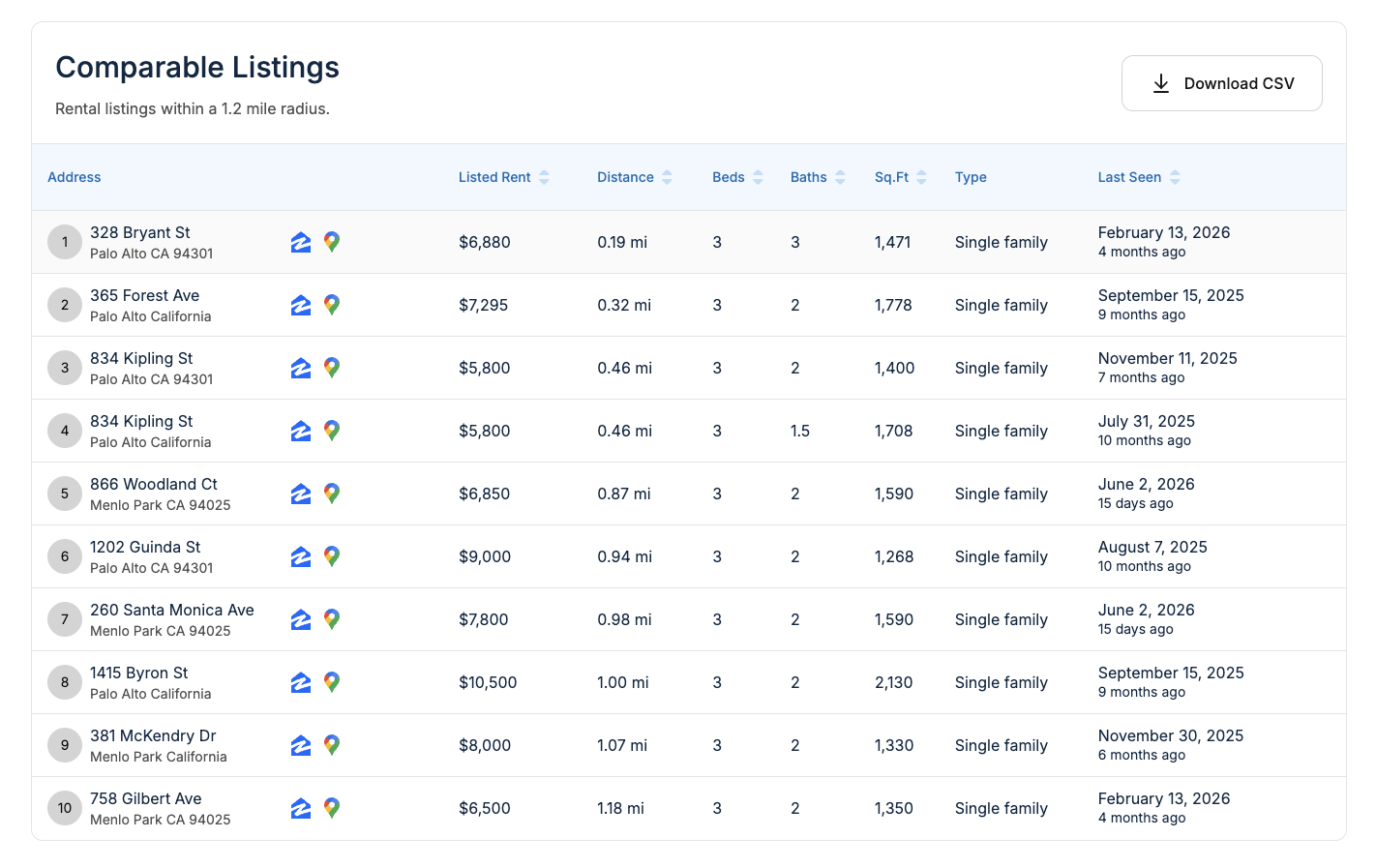
The last-seen dates and listed rents in the comp table tell you whether a premium price has actually leased nearby — or whether you would be the only one testing it.
A framework for rent optimization
- Run a market-level estimate for the address.
- Review comparable units and their time on market.
- Find the median, not the max.
- Start 2–5% below the median.
- Monitor inquiries in the first 7–10 days.
- Adjust on real demand signals.
Why median beats top-of-market thinking
Outlier listings distort expectations. The median reflects where deals actually close, not where landlords hope they will. Pricing near the median typically delivers:
- More applicant volume.
- Shorter days on market.
- Higher annualized rent after vacancy.
This is why professional operators track medians, percentiles, and lease velocity — not just asking prices.
The takeaway
The best rent price is not the highest number. It is the one that maximizes annual net income. In many markets, leasing faster at a modest discount beats waiting months for a premium tenant, as the worked example shows.
See the median, 25th, and 75th percentile rents for any address at rentest.ai/rent-estimate-by-address.
Is it better to price high and negotiate down? Usually no. Listings that sit longer tend to lease for less than if priced right from day one.
How much does one vacant month cost? Roughly 8% of annual rent, before utilities and carrying costs.
Should I always underprice to lease faster? No. Underpricing without data cuts returns. The goal is strategic pricing, not speed alone.
Do apartments and houses behave differently? Yes. Apartments respond faster to price changes; single-family homes tolerate longer lease-up.