
Rental Property Investing: Single-Family vs. Multifamily
Pick the wrong property type for your goals and you fight your own portfolio for years. A single vacancy in a single-family home wipes out 100% of that rent until it re-leases; the same vacancy in a fourplex costs you a quarter.
That one fact captures the whole trade-off. Single-family rentals favor stability and resale. Multifamily favors cash flow and scale. This guide compares the two so you can match the choice to your budget, timeline, and risk tolerance.
What a single-family rental is
A single-family rental is a standalone home for one household, usually in a suburban or residential neighborhood. Cash flow rides on a single lease.
Advantages:
- Lower entry cost — often cheaper to buy than multifamily, so it's accessible to first-time investors
- Longer tenancies — single-family tenants tend to stay put, cutting turnover and vacancy
- Broad resale demand — both investors and owner-occupants buy houses, so exits are easier
- Strong demand — single-family rental demand has grown steadily
Drawbacks:
- One income stream — returns per property are lower than multifamily
- All-or-nothing vacancy — one empty unit means 100% of the rent is gone
- Slow scaling — ten units means ten separate purchases, ten closings, ten loans
What a multifamily rental is
A multifamily property holds two or more units — a duplex, triplex, or fourplex — each with its own tenants. One building, multiple income streams.
Advantages:
- Faster scaling — one fourplex adds four units under a single roof and loan
- Economies of scale — shared roof, landscaping, and plumbing lower the cost per unit
- Steadier cash flow — multiple rents mean a single vacancy hurts less
- House-hacking — live in one unit while the others cover most of the mortgage
Drawbacks:
- Higher purchase price — more capital up front and stricter financing
- More management — more tenants, more maintenance requests, more turnover events
- Thinner resale market — fewer buyers than for single-family homes
The trade-off in numbers
The table assumes a $400,000 single-family home renting at $2,400 and a $640,000 fourplex renting at $1,500 a unit. Real numbers vary by market, but the shape holds.
| Factor | Single-family ($2,400) | Fourplex (4 × $1,500) |
|---|---|---|
| Gross monthly rent | $2,400 | $6,000 |
| Entry price | Lower (~$400k) | Higher (~$640k) |
| One vacant unit | -100% of rent | -25% of rent |
| Units per purchase | 1 | 4 |
| Resale buyer pool | Large | Smaller |
| Management load | Low | Higher |
Multifamily wins on rent collected and vacancy cushion. Single-family wins on entry cost and exit flexibility.
Validate the rent before you buy
Both strategies live or die on the rent assumption. Before you make an offer, confirm the income with real comps instead of a seller's pro forma.
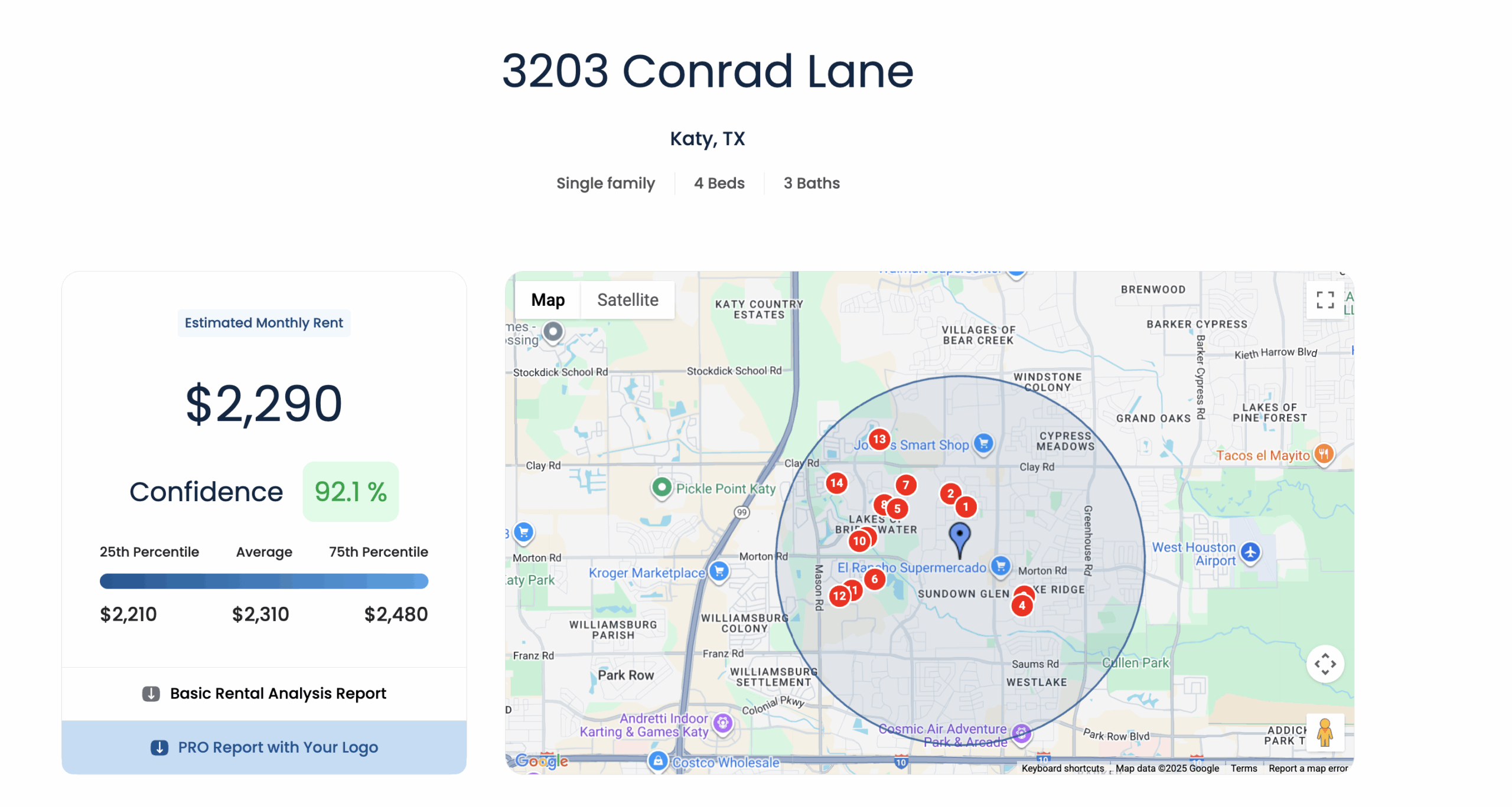
For a single-family home, run the address and check the comp set. For a fourplex, estimate each unit type separately and add them up — don't trust a blended number on the listing.
Which is right for you
Choose single-family if you're risk-averse, want to start small, or value long tenant stability and an easy exit.
Choose multifamily if you want higher monthly income, faster scaling, and you don't mind managing more tenants.
Many investors hold both over time. The right first move depends on your capital, your timeline, and how much management you want to take on.
The takeaway
Single-family rentals trade cash flow for stability and easy resale. Multifamily trades higher entry cost and management for stronger income and a vacancy cushion. Both can be profitable; the question is which fits your goals.
Whichever you pick, pressure-test the rent first. Run a free rent estimate by address before you make an offer.