
How Rent Sensitivity Changes by Market Size (Urban vs Suburban vs Rural)
A $100 rent increase can be absorbed in one city and kill demand in another. The difference is rent sensitivity — how hard tenant demand reacts when you move the price.
Market size drives most of that difference. Income levels, housing supply, and how many alternatives a tenant has all shift as you move from a dense city to a small town.
This post breaks down how rent sensitivity changes across urban, suburban, and rural markets, and how to adjust your pricing for each.
What rent sensitivity means
Rent sensitivity measures how much tenant demand moves when rent changes. In a highly sensitive market, a small increase lengthens vacancy and thins the applicant pool. In a low-sensitivity market, you can push rent higher with little effect on demand.
Market size shapes this because it controls income levels, supply, and how easily a tenant can substitute one unit for another.
1. Urban markets: low sensitivity, tight bands
Large urban markets show lower rent sensitivity, especially in desirable neighborhoods. Renters tolerate higher rents because:
- Incomes are higher and dual-income households are common.
- Jobs and lifestyle demand concentrate in core areas.
- Supply is limited in the best neighborhoods.
- Rent is a smaller share of total household income.
Pricing here behaves like a narrow band, not a single number. A unit priced slightly above median can still lease fast if location and quality are strong. But push too far past local comps and demand falls off sharply.
Urban takeaway: optimize inside a tight range. Small underpricing leaves money on the table; small overpricing stalls leasing.
2. Suburban markets: moderate sensitivity, wider tolerance
Suburban markets sit in the middle. What drives their sensitivity:
- More substitutes within a short drive.
- Value comparison on space, schools, and parking.
- More family renters with firm budget ceilings.
Suburban renters are more price-aware than urban ones but still pay premiums for the right mix of space, safety, and commute. A modest increase may slow leasing without eliminating demand, especially when comparable inventory is thin.
Suburban takeaway: price competitively and lean on property features. Square footage, school district, and parking matter more than micro-location.
3. Rural and small-town markets: high sensitivity, hard ceilings
Rural and small-town markets show the highest rent sensitivity. Increases hit harder because:
- Incomes are lower and more uniform.
- Job growth is limited.
- Few renters will stretch their budget.
- Rent-to-income ratios already sit near the ceiling.
Here rent behaves less like a curve and more like a hard cap. Exceed it and demand disappears. Even small increases can stretch vacancy significantly because tenants cannot absorb the extra cost.
This is also where comp data gets thin and far-flung — and the estimate tells you so.
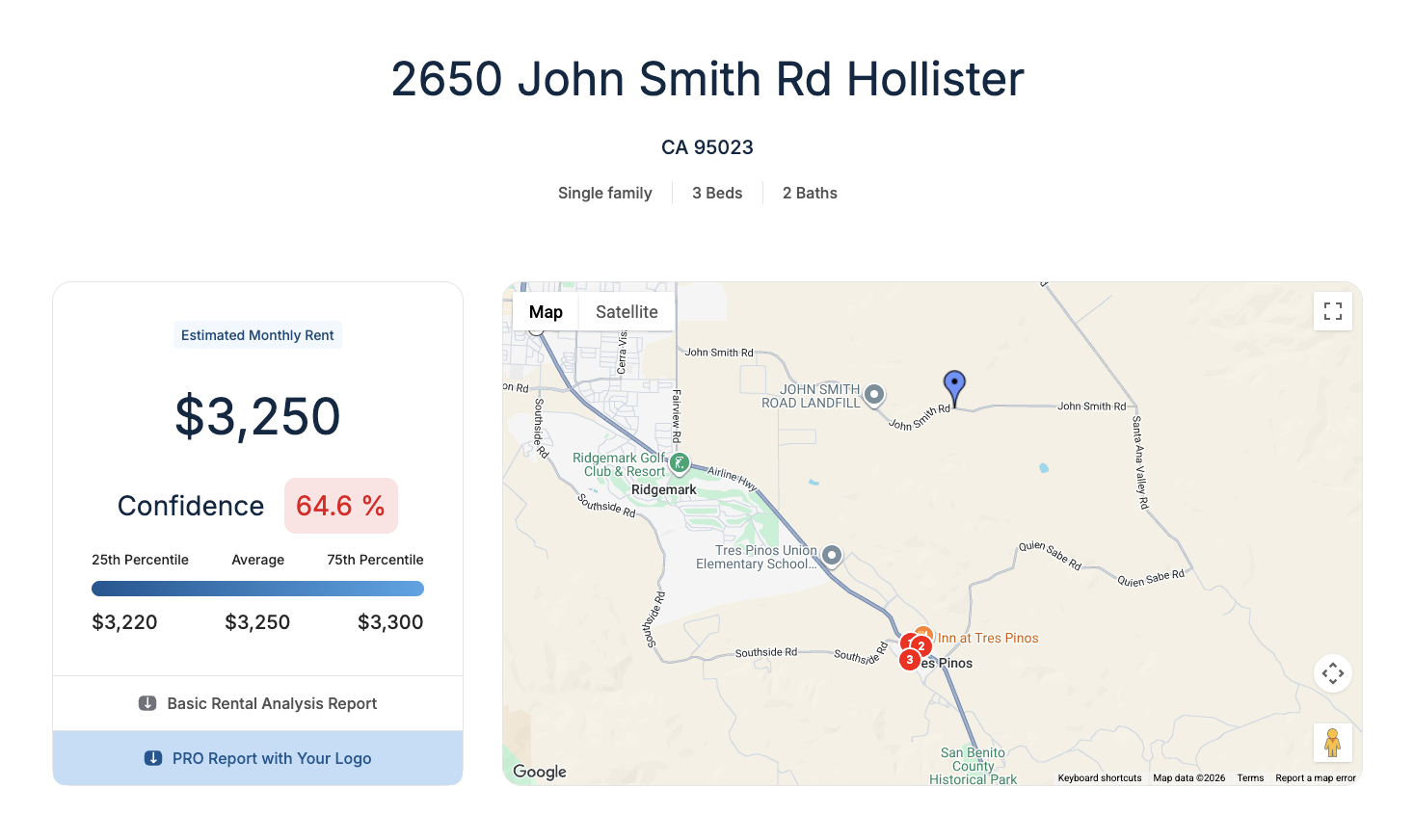
The 64.6% confidence on this rural property reflects exactly the conditions that make small markets unforgiving: few comps, far away, and a price ceiling you cannot test by guessing.
Rural takeaway: maximize occupancy first. Stability and cash flow beat squeezing marginal rent.
Rent sensitivity by market size
| Market type | Sensitivity | Pricing flexibility | Primary risk |
|---|---|---|---|
| Urban | Low–moderate | Narrow bands | Overpricing past comps |
| Suburban | Moderate | Moderate range | Ignoring nearby substitutes |
| Rural | High | Very limited | Vacancy from small increases |
How to adjust pricing by market
- Identify your true market type — not just the city name on the map.
- Use median rent, not the average, to anchor the price.
- Watch vacancy response to small rent changes.
- Track days-on-market after every reprice.
- Adjust in increments, never in leaps.
A rent estimate by address anchors pricing to actual nearby behavior instead of assumptions, and the confidence score flags when you are in thin-market territory.
Common mistakes across market sizes
- Applying urban logic to a rural market.
- Ignoring rent-to-income constraints.
- Overweighting national rent trends over local data.
- Assuming demand elasticity is uniform everywhere.
The takeaway
Urban markets reward precision, suburban markets reward value alignment, and rural markets reward affordability discipline. Treating all three the same leads to mispricing, longer vacancies, and missed returns. Match your rent strategy to local sensitivity, not headlines.
Check where your unit sits — and how confident the data is — at rentest.ai/rent-estimate-by-address.
Are urban renters less price-sensitive? Generally yes, but only inside a narrow band. Exceed comps too far and demand drops fast.
Why are rural markets more rent-sensitive? Lower incomes and limited budget flexibility create hard pricing ceilings.
Do suburban markets behave more like urban or rural? They sit in the middle — moderate sensitivity, with more weight on value and space.
What data matters most? Median rent, active comps, and days-on-market beat national averages.